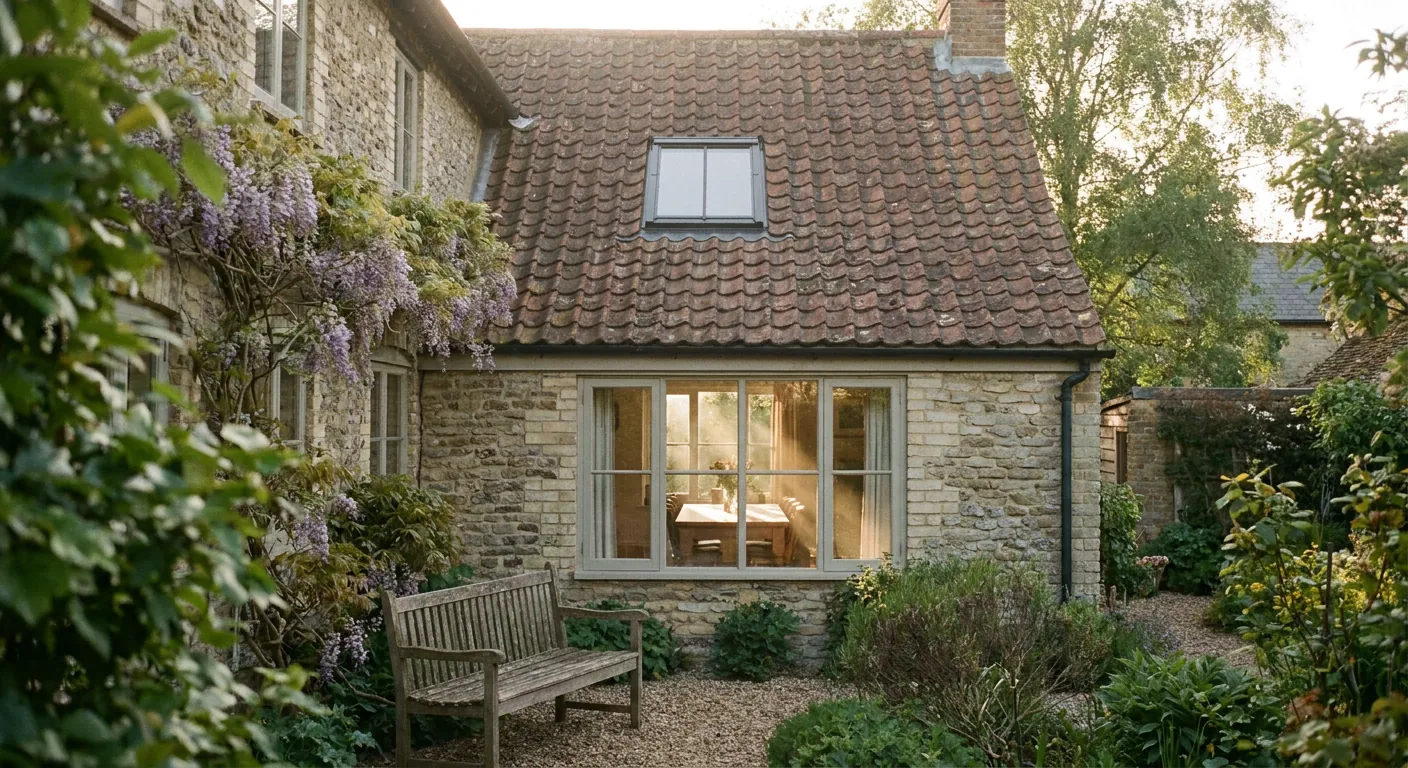
How an opening conservation rooflight works
On a typical opening conservation skylight or rooflight, the glazed sash is hinged along its top edge and swings outwards from the bottom, held open by a stay you set by hand.
When the sash is closed it sits down inside the frame, so from the street the unit reads as flush with the slates or tiles, which is the whole point of a conservation profile. Opening it lifts the lower edge of the sash clear of the roof covering and lets air move through the gap at the bottom. Because the hinge sits at the top, the open sash acts a little like a hood: rain falling straight down tends to run off the glass rather than into the room, although a sash left wide open in wind-driven rain will still let water in.
The stay is the part that sets how far the sash opens. Many makers fit a stay with several notched positions, from a narrow ventilation setting to a wider one, and some add a lockable night position. The exact opening angle, and whether a given size is offered as opening at all, varies by maker and by size, so we confirm it against the specification for the unit before it goes on the light plan. If you want the background on what makes a unit a genuine conservation rooflight in the first place, see what makes a conservation rooflight.
The opening types you will be offered
Three arrangements cover almost every conservation range: fixed, top hung and side hung, and each suits a different room and a different reach.
| Type | How it moves | Suits |
|---|---|---|
| Fixed | Does not open | Light only, high or hard-to-reach slopes |
| Top hung | Bottom edge pushes out on a stay | Loft rooms, bathrooms, stairwells |
| Side hung | Swings out like a casement | Access or escape sizes, where offered |
A fixed unit gives the cleanest sightlines and nothing to operate, which makes it a sensible choice where a rooflight is purely there for daylight, such as over a dark landing or high in a vaulted ceiling. Top hung is the everyday opening version. Side hung sashes appear in some ranges, usually in the larger sizes intended for roof access or as an escape route from a loft room; the rules for that are different, and they are covered in can a conservation rooflight be an escape window.
Reach: the question that decides the choice
An opening rooflight is only useful if someone can actually open it, so the height of the handle above the floor matters as much as the sash itself.
In a loft bedroom in a Romsey or Petersfield terrace, the rooflight usually sits low enough on the slope that the handle is within arm's reach from the floor, and a plain manual stay is all you need. Put the same unit higher up the slope, or into the pitched ceiling of a barn or a converted outbuilding, and the handle can end up well above head height. At that point there are three routes:
- A hand stay, where the bottom of the sash is within easy reach standing on the floor.
- A pole or winder, on ranges that offer a pole-operated opener, so you can open and close the sash from below without a stepladder.
- An electric actuator, hidden in or behind the frame, for rooflights that are simply too high to reach or that you want to close automatically when it rains. That option has its own page: can a conservation rooflight be electric.
Position on the slope feeds straight into this. A rooflight set lower down is easier to reach but can sit closer to the gutter line than an officer would like, while one pushed up towards the ridge is tidier in the roofscape but harder to open by hand. The balance is discussed in how far from the ridge a rooflight should be.
Why opening matters for the light and the heat
Warm air collects at the highest point of a room, and an opening rooflight is the one outlet placed right where that air gathers.
That matters most on a south or west facing slope. A small conservation rooflight on a south slope can still put a bright patch of sunlight on the floor for several hours of a summer afternoon, and in a loft room under a slate roof the heat builds quickly. A fixed unit can only be controlled with glass and blinds; an opening one lets that warm air out through the top of the room. Under Part F, an opening rooflight can also contribute to purge ventilation where its free opening area is declared, which is a matter for the Building Control submission rather than for guesswork. We handle the Building Control notification where the work is notifiable.
On a north slope the case for opening is about fresh air rather than heat, and a fixed unit is a reasonable choice where the room already has a window. In bathrooms, an opening sash helps clear steam, and the other points to weigh there are in putting a conservation rooflight in a bathroom. We work through all of this in the written light plan that comes with every quote; our general method is set out on how we plan the light.
Does an opening sash change the planning view?
The planning judgement on a conservation rooflight is generally about how it looks closed on the roof: size, position, profile, glazing bars and number.
A top hung sash that closes down flush looks the same on the slope as a fixed unit of the same size, so choosing an opening version is not, in itself, the usual point of discussion. Officers look at the same things either way, and those points are listed in what conservation officers look for in a rooflight. There is one opening-related detail in permitted development worth knowing: on a side-facing slope, Class C requires the rooflight to be obscure glazed and non-opening unless the opening part is more than 1.7m above the floor of the room. Where a listed building or an Article 4 direction applies, the whole unit needs consent, and the application should state whether it opens. If you are unsure of your position, the guide to rooflights in Cambridge conservation areas explains how to check. For the full service, see conservation rooflight installation in Cambridge, or book a light survey.
Questions people also ask
Can I open a conservation rooflight at night securely?
Many ranges offer a stay with a locked ventilation position, so the sash can stay slightly open without being free to swing wider. What is available depends on the maker; locks and glass for security are covered in are conservation rooflights secure.
Can a fixed conservation rooflight be made to open later?
Generally not. A fixed unit is built without a hinged sash, so turning it into an opening one means replacing the whole rooflight. If there is any chance you will want ventilation, specify an opening unit from the start.
Do opening conservation rooflights let in less light than fixed ones?
The difference is small. An opening sash sits inside an outer frame, so the frame can be a little wider than on some fixed designs, but on a slim steel conservation unit the glass area is very similar. Glazing bars have a larger effect, as explained in does a conservation rooflight let in less light.
Can a conservation rooflight have trickle vents instead of opening?
Some ranges offer background ventilation in the frame, which gives a small, constant airflow without opening the sash. It does not replace an opening sash for clearing heat or steam. The options are set out in do conservation rooflights have trickle vents.
