Where the motor sits in a slim conservation frame
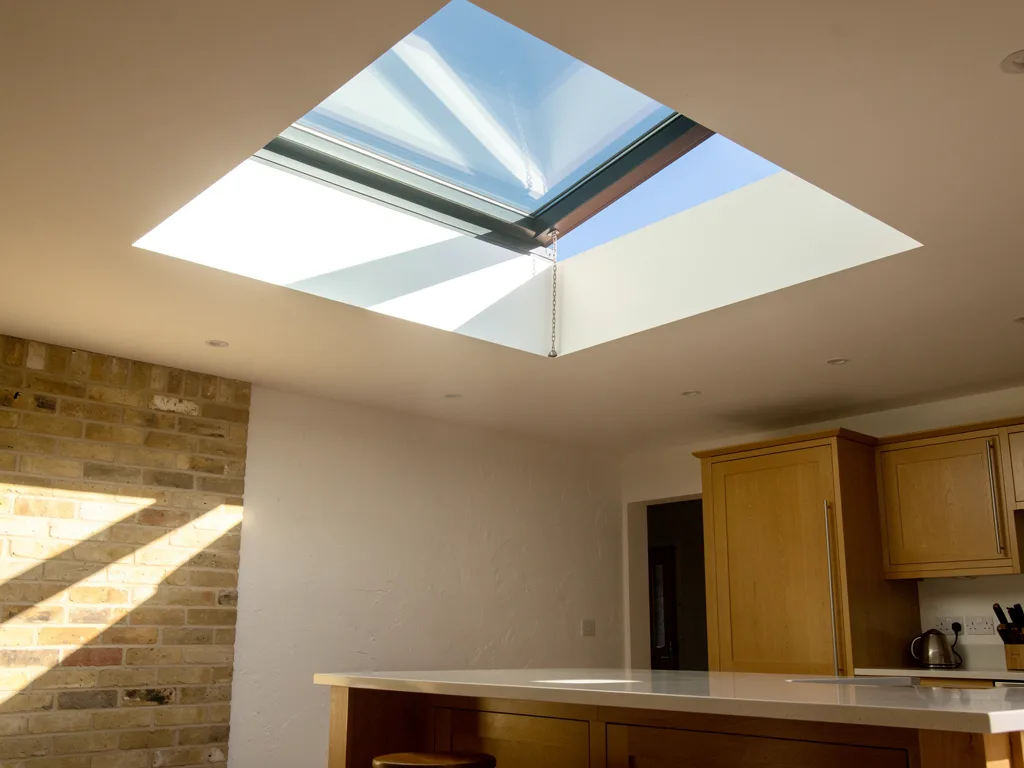
The actuator goes on the room side of the rooflight, fixed to the frame or the lining, and pushes the opening sash outwards. Nothing about it is visible from the street.
A conservation rooflight is built around a narrow steel frame that sits flush with the tiles or slates, so there is very little room inside the frame itself for mechanical parts. Most electric versions use a compact chain or spindle actuator mounted along the bottom or side of the inner frame, with the motor housing tucked against the lining. Some manufacturers conceal more of the mechanism than others, and the exact arrangement varies from range to range, so it is worth looking at the specific unit rather than assuming every electric conservation skylight hides its motor the same way. What stays the same is the outside: the sash, the integral glazing bar if you have one, and the flush profile are unchanged. If you want the background on those external details, our guide to what makes a conservation rooflight covers them.
Inside, the actuator is usually a slim box of a few centimetres in depth, finished in white, grey or black. On a plastered lining it reads as a small fitting rather than a feature. Where the lining is shallow, as it often is in the steep front slopes of Victorian terraces in Romsey and Petersfield, we check at the survey that the actuator will clear the plasterboard and any blind before the order is placed.
Does going electric affect planning or listed building consent?
For planning, the question is almost always about the rooflight's size, position and profile, not about how it opens. An electric unit that looks identical from outside is judged the same way as a manual one.
In a conservation area, a conservation officer looks at how the rooflight sits in the roof: how many there are, where they are placed on the slope, and whether they stay flush. The opening mechanism does not change any of that. Our guide to rooflights in Cambridge conservation areas explains how Greater Cambridge Shared Planning approaches those points.
A listed building is different, because consent covers the interior as well as the exterior. Running a new cable through historic plaster, lath or timber, or fixing a switch to an old wall, can count as works that affect the building's character. Whether it does depends on the building and on how the cable is routed, so it is a question for the conservation officer rather than something to assume either way. If you already need consent for the rooflight, it makes sense to show the power route and controls in the same application. See listed building consent for rooflights for how that application is put together.
Power, controls and rain sensors
Electric rooflights run from mains power or, on some models, from a small solar panel and battery. The mains option needs a qualified electrician to bring a supply to the frame.
A typical set-up looks like this:
- Supply: a fused spur near the rooflight, with a short cable run to the actuator. On a loft conversion this is easiest to plan before the ceiling is boarded.
- Control: a wall switch, a handheld remote, or both. Some ranges connect to smart home systems; check compatibility with the specific model.
- Rain sensor: a small sensor on the frame that closes the sash within seconds of the first drops. Sensitivity can usually be adjusted so heavy dew does not trigger it.
- Manual override: most actuators have a way to close the sash by hand in a power cut. Ask how it works on the model you are considering.
Solar versions avoid the cable run, which can help on a listed interior, but the panel needs to sit somewhere visible to the sky. On a conservation roof that small panel is a detail an officer may want to see, so we treat it as part of the planning picture.
When electric opening is worth it
The case for a motor is reach. If you can stand under the rooflight and open it by hand, a manual unit is simpler and costs less. If you cannot, electric is often the only way it will get opened.
Conservation rooflights are often placed high on the slope to keep them tidy and away from the eaves, and they commonly go into rooms with tall ceilings: stairwells, galleried barns, vaulted bedrooms in old cottages. Warm, stale air collects at ceiling level, so a high opening sash is exactly where you want ventilation, and it can form part of the purge ventilation for a room under Part F if its free opening area is declared. That only helps if someone opens it.
Light and heat come into it too. A conservation rooflight on a south or west slope lets in a strong patch of sun on summer afternoons, and in a small, high-ceilinged room that heat builds up quickly under the ceiling. Being able to vent the top of the room at the press of a button, and have it close itself when rain arrives, does as much for comfort as the glass choice. We cover glass options in solar control glass in conservation rooflights, and the wider orientation picture in how we plan the light.
| Situation | Manual | Electric |
|---|---|---|
| Within easy reach | Simple, suits | Optional |
| High stairwell or vault | Rod or pole | Suits well |
| Listed interior | No wiring | Route needs care |
| South slope, summer heat | Hard to use | Easy venting |
Fitting an electric conservation rooflight
The installation into the roof is the same as for a manual unit. The extra work is the cable route, the switch position and a test of the actuator and sensor before the lining is finished.
We set the frame flush with the roof covering, dress the flashing to suit the slate or tile, and fit the lining. The electrician's supply is best arranged so the cable is in place before the lining goes up, which avoids chasing into new plaster later. Once powered, the sash is run through its full stroke, the rain sensor is tested, and the limits are checked so the sash cannot strike a blind or the lining. Where the work is notifiable, we handle the Building Control notification for the rooflight. The electrical supply is a separate item carried out by the electrician. For the parent service and what is included on the day, see conservation rooflight installation in Cambridge, and for how cost drivers such as an actuator and sensor affect a quote, see our rooflight and skylight costs page.
Questions people also ask
Can I add a motor to a conservation rooflight I already have?
Sometimes. A few ranges offer a retrofit actuator kit, but many older or manual units were not designed to take one. If your existing skylight is tired as well as hard to reach, replacing it with an electric version is usually the cleaner route. We look at this at the survey.
What happens to an electric conservation rooflight in a power cut?
It stays where it is. If it was open, you close it with the manual override, which varies by model. Units with a battery backup may be able to close on their own. Check the arrangement before choosing.
Are electric conservation rooflights noisy?
Actuators make a low hum for the few seconds they run. It is noticeable in a quiet bedroom but brief. Nothing runs once the sash has stopped.
Do electric models still have locks and ventilation options?
The actuator itself holds the sash closed, and many ranges add locking and background ventilation choices on top. See are conservation rooflights secure and can conservation rooflights open for the opening and security options side by side. To see where an electric skylight would work in your roof, book a light survey.