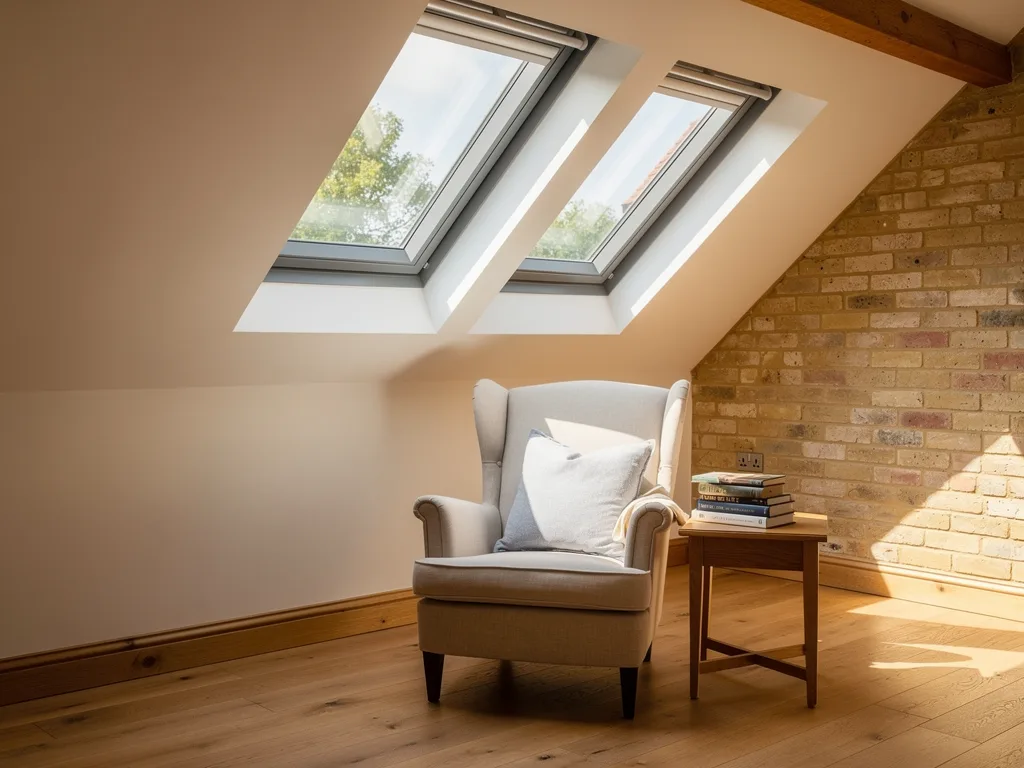
Why glass in the slope collects more daylight
A window tilted back towards the sky sees more of it, and the part it sees is brighter, so the same pane admits more light than it would standing upright.
The geometry is simple. A vertical window can only ever see half the sky dome at best, from the horizon upwards, and in a street of terraces the lower part of that half is filled with roofs, chimneys and trees. A pane tilted at 45 degrees sees roughly 85 per cent of the sky dome, and a flat rooflight sees all of it. On a grey Cambridge day, when there is no direct sun at all, the sky overhead is also about three times brighter than the sky near the horizon (that is the standard overcast sky model used in daylight design). A roof window looks up at that bright zenith; a dormer window looks across at the dim band just above the rooftops opposite.
Then there is the depth of the opening. A dormer window sits at the front of a small box, with cheeks either side and a roof above, and those surfaces trim the sky it can see from inside. A roof window sits in the plane of the roof, and with splayed reveals its lining throws the light wider still. Manufacturers often say a roof window gives up to twice the light of a vertical window of the same size. Treat that as a rough guide, since it depends on pitch, orientation and what is outside, but the direction of the difference is sound physics.
Where the light lands in the room
A roof window pours light down onto the floor and the lower walls; a dormer window sends it horizontally across the room at eye level.
This is the difference you feel most, and it matters as much as the amount. Light from a roof window arrives from above, so it spreads evenly over the floor, the bed or the desk and reaches well into a deep loft. On a south or west slope it also brings a sun patch that moves across the room through the day, which is lovely in March and a lot to live with in July. Light from a dormer window comes in low and flat. It lights the far wall brightly, leaves the corners either side of the dormer quieter, and gives a softer gradient from front to back.
Both behave differently through the year. Cambridge sits at about 52 degrees north, so the noon sun climbs to around 61 degrees in midsummer and only 14 degrees in midwinter. A south-facing roof window meets the high summer sun almost face on, which is why it can overheat a loft without the right glass and an external blind (our answer on whether a roof window will make your loft too hot covers this). A vertical dormer window receives that same summer sun at a glancing angle and lets in far less of its heat, but it welcomes the low winter sun straight in. That seasonal trade is part of what a light plan works through before anything is cut.
What a dormer gives that a roof window cannot
A dormer adds usable space and a level view; a roof window adds light while leaving the roof shape as it is.
Light is only one part of the choice in a loft. A dormer raises part of the roof, so it creates full standing height and floor you can actually use, which is often what makes a loft conversion work on a narrow terrace in Romsey or Petersfield. Its window gives the horizontal view out that people expect from a room, and a sill at a normal height feels familiar. A roof window gives none of that extra space. What it gives is light, sky and ventilation for a fraction of the structural work, often fitted from inside in a day or two, with the roof line left intact.
| Question | Roof window | Dormer window |
|---|---|---|
| Light per pane | Higher | Lower |
| Where light falls | Floor, from above | Across, at eye level |
| Summer heat, south | Needs control | Easier |
| View out | Mostly sky | Level view |
| Headroom | No change | Adds height |
| Roof works | Small opening | New structure |
The view point can be narrowed. A roof window set with a sensible sill and head height, as our guide to positioning a roof window in a room explains, gives a view of gardens and trees as well as sky when you stand or sit near it.
Using both in a Cambridge loft
On many Cambridge terraces the answer is not one or the other: a dormer at the back for space, roof windows on the front slope for light.
That pattern suits the city well. A rear dormer can often be built as permitted development on a house outside a conservation area, subject to volume limits and design conditions, while a dormer on a front slope facing the road needs planning permission and is rarely welcomed. In conservation areas, which cover many of the older terraced streets, dormer permitted development rights do not apply at all, and Greater Cambridge Shared Planning will look closely at any change to the roof. Rooflights that sit close to the roof plane are treated more lightly, although a conservation-style flush unit is usually expected and an Article 4 direction can remove the allowance. Always check the constraints on your own house before relying on either route.
In practice the dormer gives headroom over the stairs and a bathroom or dressing area, and two or three roof windows in the front slope light the main room from above. Because the roof windows face the sky rather than the house opposite, they can end up doing more of the lighting work than the dormer's larger pane. Our guides to roof windows for loft conversions and how many roof windows a loft needs go further into numbers and spacing, and if a window has to serve as a means of escape, the rules in roof windows and fire escape apply to whichever you choose.
Whichever mix suits your roof, the aim is the same: light where you use the room, heat under control and a view that feels right. Roof window installation in Cambridge sets out how we specify and fit them, and you can book a light survey to have the sun path checked on your own slopes.
Questions people also ask
Is a roof window brighter than a dormer on a cloudy day?
Yes. Under an overcast sky the brightest light comes from overhead, and a pitched roof skylight faces that part of the sky while a dormer window faces the dimmer band near the horizon. The difference between them tends to be greater on a dull day than on a sunny one.
Does a bigger dormer window catch up?
It can. A dormer window with a good deal more glass than a roof window may give a similar amount of daylight, but it needs a wider dormer, which means more structure, more cost and more planning scrutiny. Adding a second roof window is usually the lighter way to get the same result. See types of roof window for sizes and opening styles.
Which is better for a north-facing loft?
A roof window, in most cases. On a north slope it gives cool, even, glare-free light, which suits a study or studio well. Our answer on roof windows on a north facing roof explains what to expect.
Can a dormer have a roof window in its own roof?
Where the dormer roof is pitched, sometimes, subject to the pitch and the structure. On a flat dormer roof a flat rooflight is the usual choice. Either way it adds light from above to a room that the dormer's vertical window lights from the side.
