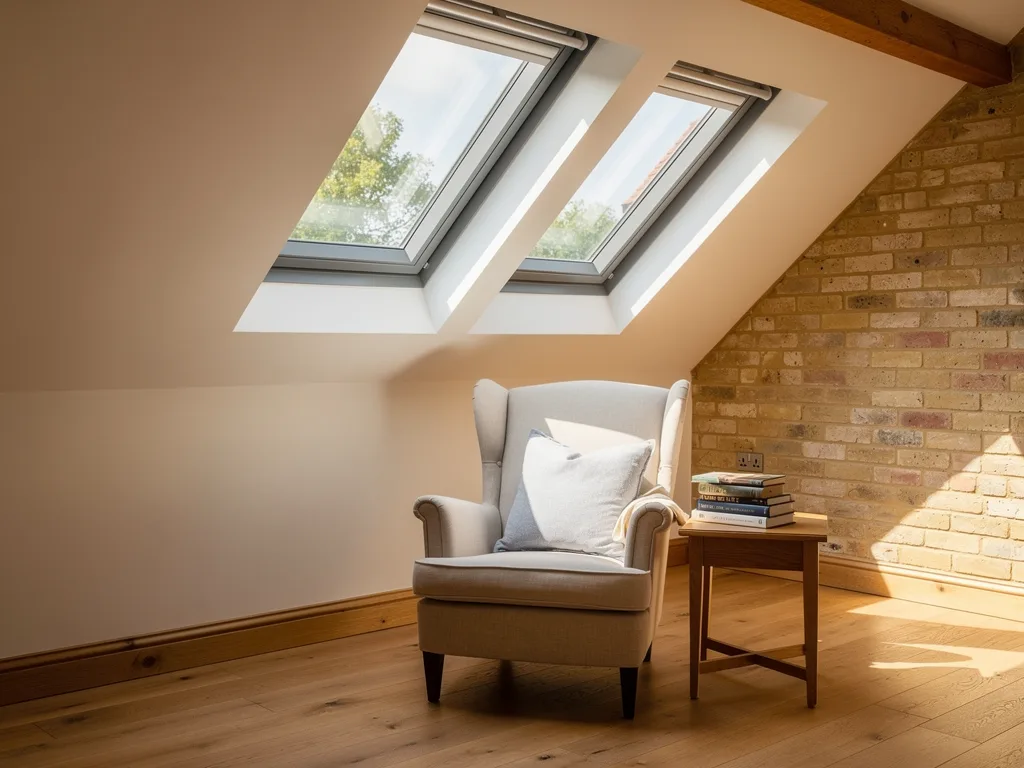
Why a clean rooflight matters more than a clean window
A rooflight looks at the sky, so it collects everything that falls from it, and a dirty pane overhead costs a room more light than the same film of grime on a wall window.
Rain washes a vertical window fairly well. A skylight on a shallow slope, or a flat rooflight on an extension, holds water for longer, and as that water dries it leaves behind whatever it was carrying: dust, pollen, soot from wood burners, bird droppings and the fine grey film that settles on any glass near a busy road. On a flat roof built to the usual minimum fall of around 5 degrees, water moves slowly and tends to gather along the lower edge of the glass, which is where a tide mark of dirt builds up first.
The effect on the room is gradual, which is why it goes unnoticed. The light still arrives, but it is softer and greyer than it was, and the sun patch on the floor loses its crisp edge. In a deep Victorian terrace in Romsey or Petersfield, where the rooflight over the back kitchen may be the only strong daylight the room gets, that loss is felt most on dull days from November to February, when there is little light to spare.
Cambridge has a few local habits that make this worse. The land around the city is flat and farmed, so spring and late-summer dust drifts in off the fields. Tree-lined streets bring leaf fall in autumn, and lime trees drip a sticky honeydew in summer that grips glass and frames. The water is hard, so rinsing with tap water can leave chalky spots once it dries. None of this harms a well-made rooflight, but each has its own cleaning answer, set out below.
Care also keeps a rooflight working. Opening sashes, hinges, gaskets, drainage paths and electric openers all do better when they are kept clear and looked at a couple of times a year. This guide covers that routine: what to clean, how, how often, and the signs that a unit has reached the end of its life. It sits alongside our rooflight and skylight installation work in Cambridge, and it applies to any make.
One rule comes before everything else here: follow the manufacturer's care instructions for your unit. Glass coatings, frame finishes and gasket materials differ between brands, a cleaner that suits one can dull another, and some product warranties depend on the unit being looked after as the maker describes. The care leaflet is usually near the back of the installation paperwork; if it is lost, the make and model are often on a label on the frame, visible with the sash open, and our answer on how to tell what skylight you have explains where to look. Where the leaflet and this guide disagree, the leaflet wins.
Cleaning the glass and its coatings
The inside face of a rooflight is the easy half, and for a roof window you can often reach the outside from indoors as well, by rotating the sash.
For the room-side pane, a bucket of warm water with a small squirt of mild washing-up liquid, a soft microfibre cloth or a sponge, and a rubber-bladed squeegee are all you need. Wipe from the top down, squeegee off, and dry the edge of the glass where it meets the frame so water does not sit against the gasket. Avoid scouring pads, the rough side of kitchen sponges, razor scrapers and ammonia-based or abrasive cleaners unless the maker's guidance allows them.
Because of Cambridge's hard water, a final wipe with deionised or distilled water (sold for irons and car batteries) stops the faint white spotting that tap water can leave as it dries. This matters more on a rooflight than on a wall window, because you look up at the glass against a bright sky, which shows every mark.
Many pitched roof windows, such as centre-pivot models, are designed so the sash can be turned through almost 180 degrees and held with a locking bolt, which puts the outside face of the glass inside the room for cleaning. Check the maker's instructions for how the cleaning position works on your model, keep a firm grip on the sash as it turns, and make sure the bolt is engaged before you let go. Top-hung roof windows usually open outward and are harder to reach this way.
Fixed flat rooflights and roof lanterns have no cleaning position. For these, the inside is cleaned from a stable step or platform in the room, and the outside is cleaned from the roof or from a pole, as described next. On a tall lantern over a double-height space, an extendable pole with a soft head is safer than stretching from the top of steps.
Self-cleaning and other coatings
Some outer panes carry a self-cleaning coating that uses daylight to break down organic dirt and makes rain spread in a sheet to rinse it away. It works well on a sloping roof window, less well on a flat rooflight at a shallow fall, so it reduces cleaning rather than ending it. These coatings are easily harmed by abrasives, metal scrapers and silicone-based products such as some polishes and sealants, and many makers ask for plain water or a very mild detergent only. Low-emissivity and most solar control coatings sit inside the sealed unit, out of reach, though a few products carry one on an outer face. If you are unsure, treat the glass as coated. Our page on energy efficient rooflights covers how these coatings change the heat and light in a room.
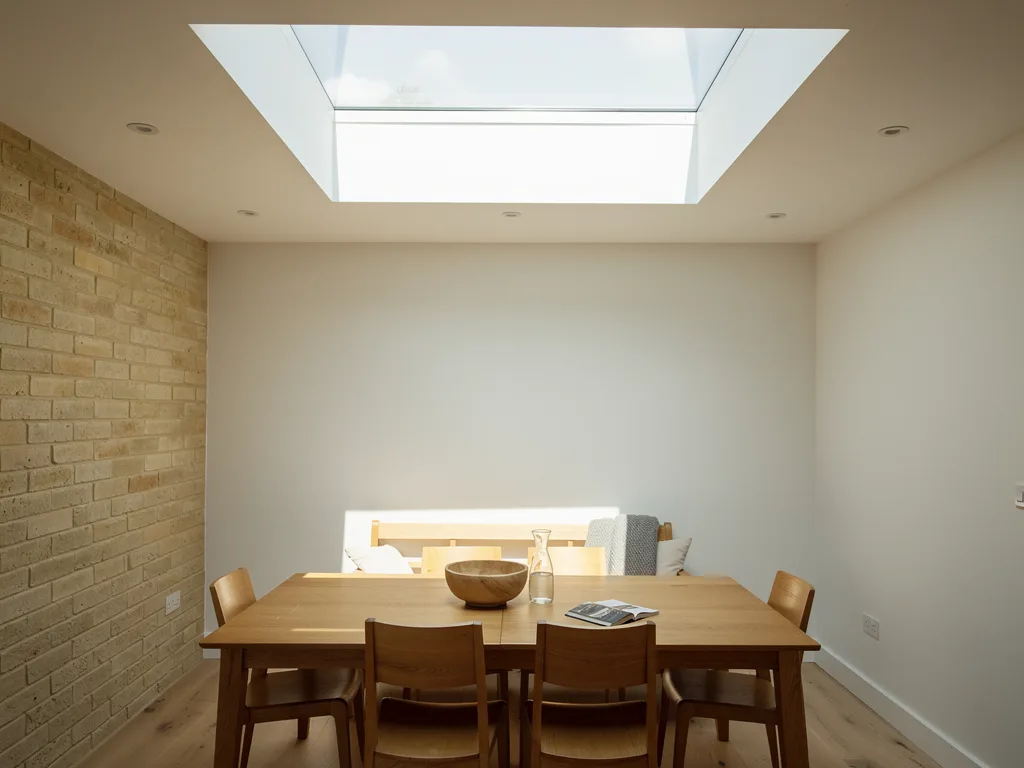
Reaching the outside safely
Working on a roof or at height carries real risk, and no clean pane is worth a fall: if you are not sure you can reach the outside of a rooflight safely, leave it to someone properly equipped.
A few points apply to every type. Never stand, kneel or lean on the glass of a rooflight unless it is a purpose-built walk-on unit designed and specified to take foot traffic; ordinary rooflights, lanterns and roof windows are not made to carry a person's weight, even when the glass is toughened or laminated. Our guide to safety glass in rooflights explains what those glass types do and do not protect against. Do not climb onto a pitched roof to reach a roof window. Avoid wet, icy or windy days, and keep children and pets out of the room below while anyone is working overhead.
On a flat extension roof that you can reach from a first-floor window, a water-fed pole with purified water lets you clean the outside of a flat rooflight or lantern from the edge of the roof or from the ground, without walking on the roof covering. Many window cleaners work this way and carry their own purified water, which dries without spotting. If you do go onto a flat roof yourself, check that the roof covering is meant to be walked on, stay well away from unguarded edges, and follow current Health and Safety Executive guidance on working at height, which is written for trades but is a sensible reference for anyone.
A walk-on rooflight is the one type designed to be stood on. Even so, the maker's guidance on cleaning products matters, because the slip-resistant finish on top of the glass, usually a sandblasted or fritted surface, holds dirt in its texture and can be dulled by the wrong cleaner. A soft brush with mild soapy water is the usual approach. More on these units is on our walk-on rooflight page.
For outside cleaning, the method is the same as inside: mild detergent, a soft brush or cloth, a gentle rinse and nothing abrasive. Pressure washers are best avoided on rooflights unless the maker says otherwise, since a close, hard jet can force water past gaskets and weathering and lift loose debris into places it should not go.
Frames, upstands and the roof around them
The frame, the kerb it sits on and the roof finish that meets it are what keep the weather out, so they deserve a look each time the glass is cleaned.
Powder-coated aluminium frames need only a wash with mild soapy water and a rinse; the maker may suggest an occasional wipe with a non-abrasive polish. uPVC frames are cleaned the same way; strong solvents and cream cleaners can dull the surface. Timber, which is common on the room side of pitched roof windows and on older conservation rooflights, is either lacquered or painted. The maker's care guidance usually says how often the lacquer or paint should be renewed, and a lacquered timber lining in a steamy bathroom will need it sooner than one in a dry bedroom.
On the outside, look at the flashing around a roof window, the upstand or kerb under a flat rooflight or lantern, and the roof covering where it turns up against them. You are looking for anything that has changed: flashing lifted by wind, moss or debris packed against the upper edge, cracked or split roofing felt or membrane at the upstand, or gaps opening where a lead or aluminium flashing meets the tiles. From the ground, binoculars on a clear day do a good job for pitched roofs.
Clearing is fine for a homeowner to do from a safe position. Lift leaves, twigs and moss away from the upper side of a roof window and from the base of an upstand with a soft brush, and keep the gutter below clear, since a blocked gutter can back water up towards the rooflight. What should not be done is to apply sealant, silicone or roofing products to a frame, flashing or gasket. Most rooflights are designed to drain water through specific paths, and a bead of silicone across one of them can trap water rather than keep it out. It may also affect the manufacturer's warranty. If something at the frame or flashing looks wrong, have the unit and the roof around it inspected by someone competent to judge it.
- Joists, with doubled trimmers either side of the opening to carry the loads of the cut joists around it.
- Deck (usually 18mm ply or OSB) with a vapour control layer laid on it.
- Insulation boards above the deck (a warm roof), often tapered to give the roof its falls.
- Waterproof membrane dressed up the upstand and over its top, so the joint is lapped, not sealed.
- Upstand, or kerb: insulated timber, finishing at least 150mm above the finished roof surface to keep standing water and splash off the joint.
- Rooflight unit fixed over the kerb, its frame skirt shedding water outside the membrane turn-up.
- Plastered reveal lining the opening from the ceiling up to the frame, finished white to bounce the light down.
- Roof falls to an outlet: designed at about 1:40 so the finished roof never falls less than 1:80.
On the room side, check the plastered or lined reveal around the rooflight for staining, damp marks or mould at the corners. Brown rings on the plaster suggest water getting in from outside. Black mould spots at the lower corners usually point to condensation on a cold surface, which is more about insulation and ventilation than about the rooflight itself; our answer on insulating around a skylight explains why that junction matters.
Gaskets, drainage paths and mist between the panes
The rubber gaskets and small drainage channels in a rooflight frame do quiet but essential work, and the sealed glass unit inside them has a finite life that no amount of care can extend indefinitely.
Gaskets are the rubber or synthetic strips that the glass and opening sash press against. Keep them clean with a damp cloth, since grit on a gasket stops the sash closing evenly. Some makers suggest an occasional treatment with a specific product to keep rubber supple; others say to use nothing. Follow the leaflet. Signs of an ageing gasket include cracking, hardening, shrinking back from the corners, or a sash that no longer closes with the same firm feel.
Many framed rooflights and roof windows include small weep holes or drainage slots, usually at the lower edge, that let any water in the frame escape. They are easily blocked by insects, grit and leaf litter. A soft pipe cleaner or a thin plastic tie, used gently, clears them; avoid anything sharp that might score the frame.
Condensation is the question people ask about most. Mist on the room-side face of the glass is a sign of warm, moist air meeting a cooler surface. It is common in kitchens and bathrooms on cold mornings, and it clears as the room warms or is ventilated. Opening the rooflight on its trickle vent or night-vent setting, running an extractor fan and keeping a blind raised a little so air can reach the glass all help.
Mist or water droplets between the panes, inside the sealed unit, is different. It means the edge seal of the glass unit has failed, moisture has entered the cavity, and the drying material in the spacer bar can no longer absorb it. That unit cannot be cleaned or brought back; the fogging will come and go with the weather and gradually worsen, and the insulating gas has usually been lost too. The answer is a replacement: sometimes the glass unit alone, where the maker supplies one for that frame, and sometimes the whole rooflight. Our page on misted and failed rooflight replacement sets out how that decision is made.
Openers, rain sensors and blinds
An opening rooflight is only useful if it opens and closes smoothly, and its moving parts reward a simple check twice a year.
For manual roof windows, open and close the sash fully, including the cleaning position if it has one, and listen and feel for stiffness, grinding or a sash that no longer sits square when closed. Wipe dust from the hinges and the handle mechanism. Only lubricate if the maker says to, and only with the lubricant they name; oil on a mechanism designed to run dry attracts grit and can make it worse. Check that ventilation flaps on the handle or top rail open and close and are not blocked with dust or cobwebs.
Electric rooflights and roof windows add a motor, a control unit and usually a rain sensor. The rain sensor is a small plate, typically on the outer frame, that closes the rooflight when it detects water. It works best when it is clean, so give it the same gentle wipe as the glass when you clean outside, and never paint over it or cover it. Test it now and then by running the rooflight open on a dry day and flicking a little water onto the sensor: the sash should close within seconds. If it does not, check the maker's troubleshooting steps before anything else.
Remote controls and wall switches need little more than fresh batteries on the schedule the maker suggests. If the motor strains, the sash stops part-way, or the unit makes an unfamiliar noise, stop using the electric opening and check the maker's guidance or have it looked at; forcing a jammed actuator can damage it. Our electric and opening rooflight page covers how these systems are specified and fitted, including power supply and control options.
Blinds and flyscreens
Blinds do much of the work of controlling heat and glare under a skylight, so looking after them is part of looking after the light in the room.
Fabric blinds on roof windows usually run in side channels. Dust the fabric with a soft brush or the brush head of a vacuum on low suction, and wipe the side channels so the blind runs freely. Most blind fabrics should not be soaked or put in a washing machine; spot-clean marks with a damp cloth as the blind maker suggests. Blackout blinds in bedrooms work by closing tightly into their channels, so any grit there will show as a line of light at dawn.
External awning blinds, which stop the sun before it reaches the glass and are the most effective way to keep a south-facing loft room cool, gather the same dirt as the rooflight; look at their fixings and fabric tension each spring. A solar-powered blind needs its small panel kept clean, or it may charge poorly on a north slope in winter.
Flyscreens on opening rooflights are cleaned by gently vacuuming the mesh, or removing them where the design allows and rinsing with plain water. If you are still deciding whether a blind is needed at all, our answer on whether a skylight needs a blind goes through it by room and orientation.
A simple care routine through the year
Two main checks a year, one in spring and one in autumn, plus a quick look after storms, keep a rooflight or skylight clear and working without making it a chore.
The timing suits Cambridge weather. Spring removes the winter grime and the first pollen before the long light of summer, and autumn clears the leaves before the wettest months and before the low winter sun, when every bit of clear glass counts. The table below is a starting point; your maker's guidance and the trees near your roof may shift it.
| When | Glass | Frame and roof | Moving parts |
|---|---|---|---|
| Spring | Clean both faces | Clear debris, look at flashing and upstand | Run openers, test rain sensor |
| Summer | Wipe off honeydew or pollen if needed | Check blinds and fixings | Use vents on hot days |
| Autumn | Clean both faces after leaf fall | Clear leaves, gutters and weep holes | Check gaskets and closing |
| After storms | Look for impact marks | Look for lifted flashing from the ground | Check sash closes fully |
A phone photo of the glass edge, flashing and reveal at each check makes gradual changes easy to spot, and is useful if you ever need to raise something with a manufacturer or an installer under a guarantee.
Rooflights under trees or near a busy road, and flat rooflights at a shallow fall, may need cleaning more often than twice a year to keep the light at its best. Roof windows on a steep slope with self-cleaning glass may need less.
When care is no longer enough
Good care keeps a sound rooflight at its best for many years, but it cannot reverse the wear that comes with age, and some signs mean it is time to plan a replacement rather than keep cleaning.
The clearest signs are mist or water between the panes that comes and goes with the weather; frames that have cracked, warped or lost their finish down to bare material; gaskets that have hardened and shrunk so the sash no longer closes firmly; openers that have become stiff or unreliable despite cleaning; and staining on the ceiling or reveal that keeps coming back. Old single-glazed or early double-glazed units are also worth reviewing on comfort grounds alone, since a modern unit loses far less heat and can carry glass chosen for how the slope actually behaves in summer and winter.
Our answer on how long skylights last covers typical service life by type and glazing. When a unit has reached the end, replacement is a chance to rethink the light as well as renew the glass: a different size, better solar control glass on a south slope, an opening unit in place of a fixed one, or a built-in blind. Our guide to skylight replacement options sets out those choices, and the rooflight replacement process explains how the work runs from survey to making good.
If you would like a view on an older rooflight in your home, book a light survey. We will look at the unit, the slope it sits on and how the room uses its light, and put a written light plan and quote in front of you before anything is decided.
Questions people ask
What is the best thing to clean skylight glass with?
Warm water with a little mild washing-up liquid, a soft microfibre cloth and a squeegee suits most rooflight glass. A final wipe with deionised or distilled water avoids hard-water spots. Always check the maker's care guidance first, particularly if the outer pane has a self-cleaning or other coating.
Can I use a pressure washer on a rooflight?
It is best avoided unless the maker's instructions allow it. A close, powerful jet can drive water past gaskets and weathering details and disturb the roof finish around the unit. A soft brush, mild detergent and a gentle rinse, or a water-fed pole with purified water, is the safer approach.
Is it safe to stand on a flat rooflight to clean it?
No, unless it is a walk-on rooflight designed and specified for foot traffic. Ordinary flat rooflights and lanterns are not built to carry a person's weight. Clean them from a safe position off the glass, and if you cannot reach them safely, use someone with the right equipment for working at height.
Why does my skylight mist up on cold mornings?
Mist on the room side is condensation from moist indoor air meeting cool glass, and ventilation usually clears it. Mist between the two panes is different: it means the sealed glass unit has failed, and the answer is a replacement of the glass unit or the whole rooflight.